Aftershave Repair Gel Market Size, Share & Demand Report By Product Type (Alcohol-Based Aftershave Repair Gels, Alcohol-Free Aftershave Repair Gels, Herbal & Natural Aftershave Repair Gels, Sensitive Skin Aftershave Repair Gels), By Distribution Channel (Online Retail, Supermarkets & Hypermarkets, Specialty Stores, Pharmacies & Drug Stores) By Region & Segment Forecasts, 2026–2034
USD 3950
Aftershave Repair Gel Market Size
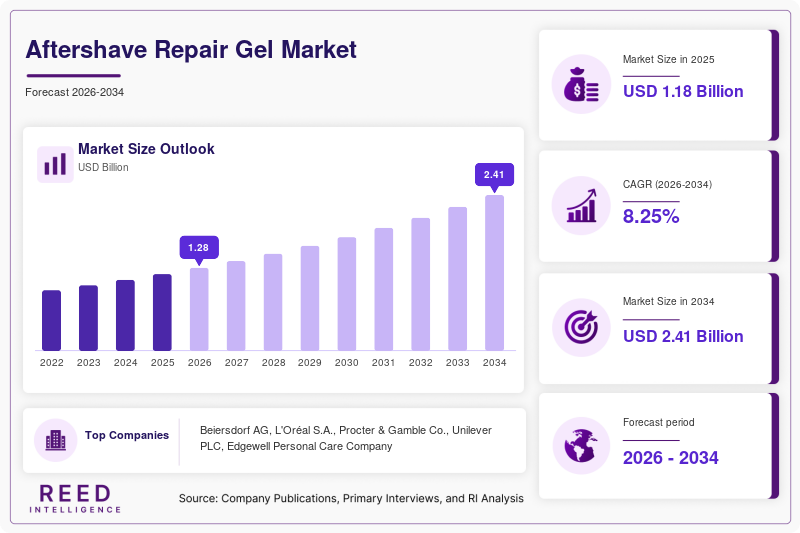
Aftershave Repair Gel market size is projected at USD 1.28 billion in 2026 and is expected to hit USD 2.41 billion by 2034 with a CAGR of 8.25%. Growing awareness regarding post-shaving skin care, rising demand for soothing formulations, and increasing penetration of premium men's grooming products are supporting market expansion. Detailed analysis of market segmentation, consumer preferences, and competitive positioning remains essential for manufacturers and investors.
The Aftershave Repair Gel Market consists of skin-repair formulations designed to reduce irritation, redness, razor burns, and dryness after shaving. Global production exceeded 620 million units in 2025, with personal grooming applications accounting for nearly 68% of total consumption. More than 57% of male consumers aged 18–45 reported regular use of aftershave skin-care products, while alcohol-free formulations contributed approximately 42% of overall revenue. Rising consumer focus on skincare wellness continues to strengthen Aftershave Repair Gel Market Share.
Aftershave Repair Gel Market Trends
Rising Demand for Natural and Skin-Friendly Ingredients
Manufacturers are increasingly incorporating aloe vera, chamomile, tea tree oil, and hyaluronic acid into aftershave repair gels. More than 210 million units of natural and organic aftershave gels were sold globally during 2025, representing annual growth of 13.4%. Consumer preference for clean-label grooming products exceeded 49%, particularly among millennials and Gen Z users. This shift is becoming a significant Aftershave Repair Gel Market Trend.
Technological advancements in dermatologically tested formulations are improving product effectiveness. Approximately 38% of newly launched products feature advanced moisturizing complexes and anti-inflammatory ingredients. Premium products generated over USD 420 million in revenue during 2025, while e-commerce sales contributed nearly 46% of total market transactions. These developments continue to reinforce the Aftershave Repair Gel Market Trend.
Aftershave Repair Gel Market Drivers
Growing Consumer Spending on Men's Grooming Products
Global spending on men's personal care products increased by more than 11% between 2023 and 2025. Over 390 million consumers regularly purchased post-shaving products in 2025, while premium grooming product penetration reached 34%. The increasing popularity of beard maintenance and facial grooming routines is accelerating product adoption. These factors collectively support Aftershave Repair Gel Market Growth.
Aftershave Repair Gel Market Restraints
Availability of Alternative Post-Shaving Products
Consumers can choose from balms, lotions, creams, and serums as alternatives to repair gels. Nearly 29% of users prefer aftershave balms, while 21% opt for moisturizing lotions. Market competition from multifunctional skincare products has intensified, with over 1,200 competing grooming SKUs launched globally in 2025. This factor moderately affects Aftershave Repair Gel Market Demand.
Aftershave Repair Gel Market Opportunities
Expansion of Premium and Dermatology-Based Product Lines
Dermatologist-recommended aftershave repair gels generated more than USD 310 million in global sales during 2025. Demand for fragrance-free and sensitive-skin formulations increased by 18%, while premium product launches rose by 15%. Emerging markets across Asia-Pacific and Latin America present substantial untapped potential, creating valuable Aftershave Repair Gel Market Insights.
Challenges in Aftershave Repair Gel Market
Raw Material Price Volatility and Brand Competition
The prices of botanical extracts, essential oils, and specialty active ingredients increased by 8%–14% between 2023 and 2025. Additionally, more than 300 brands compete globally in the men's grooming segment, increasing pricing pressure and marketing expenditures. These challenges create barriers for smaller manufacturers and influence overall Aftershave Repair Gel Market Demand.
Aftershave Repair Gel Market Segmentation
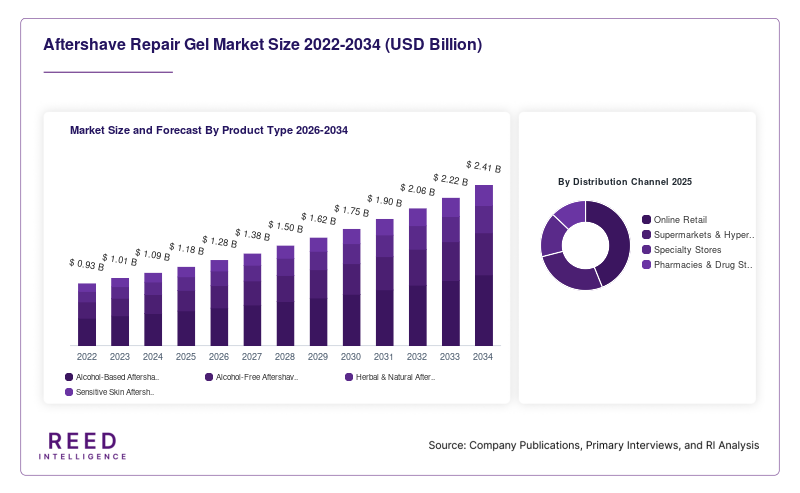
The market is segmented by product type and application. Alcohol-based repair gels maintain a leading position with approximately 44% market share, while personal grooming applications account for nearly 68% of total market revenue.
By Type
Alcohol-based repair gels account for approximately 44% of global revenue. Annual production exceeded 270 million units in 2025. These products offer fast absorption, cooling effects, and antibacterial protection, making them popular among traditional shaving consumers.
Alcohol-free repair gels represent around 42% market share. Production surpassed 255 million units annually. Formulations containing aloe vera, glycerin, and panthenol are increasingly preferred by consumers with sensitive skin due to reduced irritation risks.
Natural and organic repair gels account for approximately 14% of market revenue. Production exceeded 95 million units in 2025. These products emphasize botanical ingredients, sustainable sourcing, and clean-label positioning.
By Application
Personal grooming dominates the market with nearly 68% share. More than 420 million units were sold through retail and online channels in 2025. Daily shaving routines and increasing skincare awareness continue to drive product consumption.
Professional barbershops account for approximately 20% of market demand. Annual usage exceeded 125 million units. Professional grooming services increasingly utilize premium repair gels to enhance customer experience and reduce skin irritation.
Dermatology and skin care applications hold around 12% market share. More than 75 million units were recommended through skincare clinics and dermatology channels. These products focus on skin recovery and irritation management.
Aftershave Repair Gel Regional Market Outlook
North America Aftershave Repair Gel Regional Market
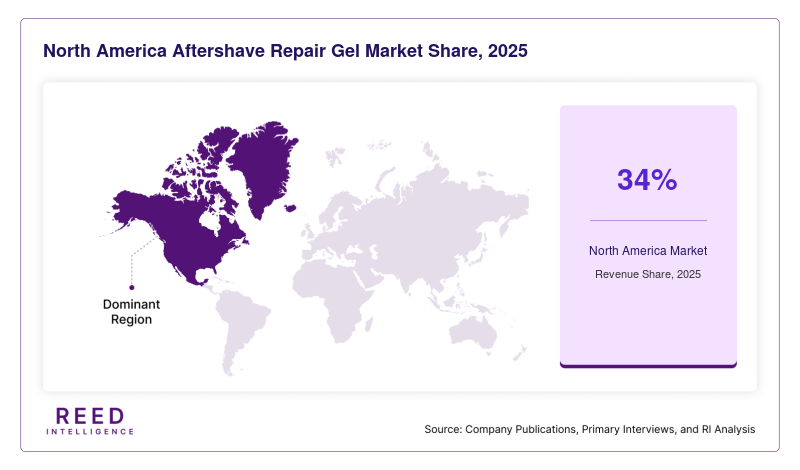
North America accounted for approximately 34% of global revenue in 2025. The United States represented nearly 79% of regional demand. More than 185 million units were consumed annually due to strong grooming product penetration and premium product adoption.
Europe Aftershave Repair Gel Regional Market
Europe held approximately 29% market share. Germany, the United Kingdom, France, and Italy contributed over 71% of regional sales. Annual consumption exceeded 165 million units, supported by well-established men's grooming markets.
Asia-Pacific Aftershave Repair Gel Regional Market
Asia-Pacific accounted for nearly 25% of global demand and remains the fastest-growing region. China, Japan, South Korea, and India collectively represented over 74% of regional sales. Production surpassed 190 million units in 2025.
Latin America Aftershave Repair Gel Regional Market
Latin America contributed around 7% of market revenue. Brazil and Mexico accounted for approximately 64% of regional demand. Growing urbanization and grooming awareness support continued market development.
Middle East & Africa Aftershave Repair Gel Regional Market
The Middle East & Africa represented approximately 5% of global revenue. The UAE, Saudi Arabia, and South Africa remain major consumption centers, with annual demand exceeding 35 million units.
Top players in Aftershave Repair Gel Market
- Beiersdorf AG
- L'Oréal S.A.
- Procter & Gamble Co.
- Unilever PLC
- Edgewell Personal Care
- The Art of Shaving
- Nivea Men
- Proraso S.r.l.
- Bulldog Skincare
- Baxter of California
- Harry's Inc.
- Dollar Shave Club
- Clinique Laboratories
- Shiseido Company Limited
- The Body Shop International
Beiersdorf AG
- Holds an estimated 15% share of the global market.
- Strong brand recognition through Nivea Men product lines.
- Operates across more than 170 countries with extensive retail distribution.
- Invests heavily in skin-soothing and dermatologically tested formulations.
- Benefits from premium and mass-market positioning, enabling broad consumer reach and consistent revenue generation.
L'Oréal S.A.
- Accounts for approximately 12% global market share.
- Maintains a diversified men's grooming portfolio across premium and mainstream segments.
- Focuses on research-driven skincare innovations and advanced moisturizing technologies.
- Strong presence in Europe, North America, and Asia-Pacific.
- Leverages digital marketing, influencer partnerships, and e-commerce channels to strengthen market penetration.
Recent Developments in Aftershave Repair Gel Market
- 2025: Beiersdorf AG expanded its Nivea Men aftershave repair gel range with sensitive-skin formulations.
- 2025: L'Oréal introduced advanced hydrating post-shave gel products featuring hyaluronic acid.
Aftershave Repair Gel Market Segments
By Product Type
- Alcohol-Based Aftershave Repair Gels
- Alcohol-Free Aftershave Repair Gels
- Herbal & Natural Aftershave Repair Gels
- Sensitive Skin Aftershave Repair Gels
By Distribution Channel
- Online Retail
- Supermarkets & Hypermarkets
- Specialty Stores
- Pharmacies & Drug Stores
By Region
- North America
- Europe
- APAC
- Middle East and Africa
- LATAM