Electric Nose Hair Trimmer Market Size, Share Demand Report By Type (Rotary Blade Trimmers, Reciprocating Blade Trimmers, Dual-Blade Trimmers), By Application (Personal Grooming, Professional Salons, Medical Use), Regional Insights & Segment Forecasts, 2026–2034
USD 3950
Electric Nose Hair Trimmer Market Size
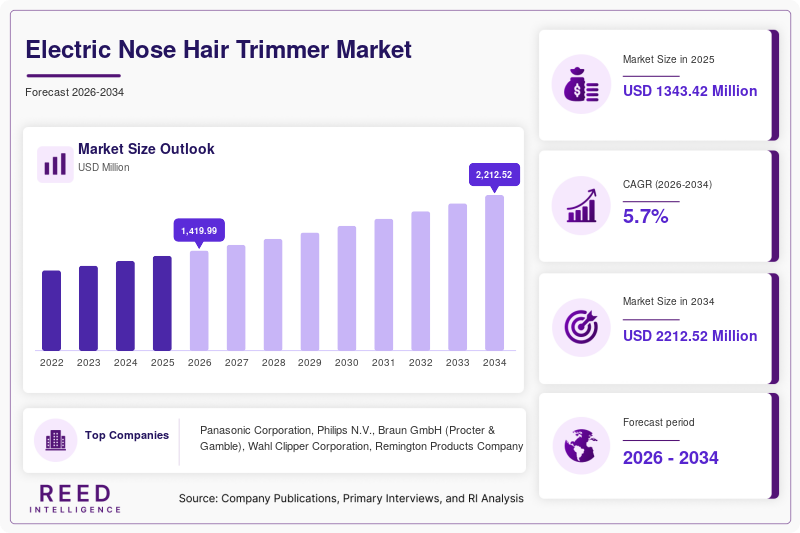
Electric Nose Hair Trimmer market size is projected at USD 1,420 million in 2026 and is expected to hit USD 2,180 million by 2034 with a CAGR of 5.7% during the forecast period. The rising consumer focus on personal grooming, coupled with the increasing availability of advanced, ergonomic trimming devices, underpins market growth. This report delivers a granular analysis of the Electric Nose Hair Trimmer market, including segmentation by type and application, competitive dynamics, and regional outlook, equipping stakeholders with actionable intelligence. The Electric Nose Hair Trimmer market remains resilient, driven by urbanization, rising disposable incomes, and the growing trend of at-home grooming.
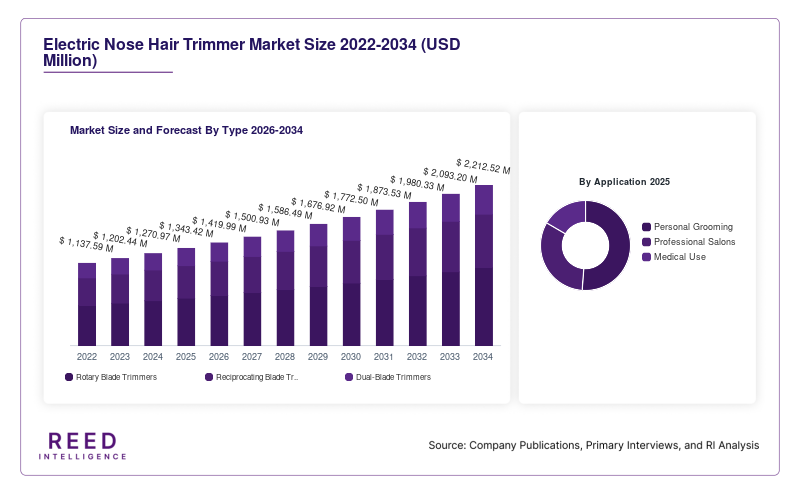
Electric nose hair trimmers are specialized grooming devices designed to safely and effectively remove unwanted nasal hair using rotating or reciprocating blades, often with protective guards to prevent nicks and cuts. These devices have become a staple in modern personal care, offering convenience, precision, and hygiene compared to manual scissors or tweezers. The global production volume of electric nose hair trimmers surpassed 95 million units in 2025, reflecting robust demand across both developed and emerging economies. Adoption rates are particularly high in North America and Europe, where penetration exceeds 55% of adult male grooming households, while the Asia-Pacific region shows the fastest uptake, growing at 8% annually. By segment, rotary blade trimmers dominate with a 48% market share, followed by reciprocating blade trimmers at 32%, and dual-blade trimmers at 20%. The Electric Nose Hair Trimmer market's expansion is further fueled by the proliferation of e-commerce platforms and the increasing influence of social media grooming trends.
Electric Nose Hair Trimmer Market Trends
Integration of Advanced Safety and Hygiene Features
The Electric Nose Hair Trimmer market is witnessing a significant shift toward devices with enhanced safety mechanisms, including rounded blade tips, hypoallergenic stainless-steel blades, and automatic shut-off systems. Approximately 65% of new models launched in 2025 incorporated at least two advanced safety features, a 15% increase from 2023. The demand for waterproof and washable trimmers has surged, with over 70% of consumers now preferring fully immersible devices for easy cleaning. Production volumes for waterproof models reached 52 million units in 2025, representing 55% of total output. Sector-specific demand is particularly strong in the premium segment, where consumers are willing to pay a 25-35% premium for devices with antimicrobial blade coatings and self-sharpening technology. The Electric Nose Hair Trimmer market's trend toward hygiene-centric design is reinforced by growing consumer awareness about bacterial accumulation in grooming tools, driving innovations in UV-C sterilization docks and replaceable blade cartridges.
Rise of Multifunctional and Smart Grooming Devices
Technological convergence is reshaping the Electric Nose Hair Trimmer market, with manufacturers introducing multifunctional devices that combine nose, ear, and eyebrow trimming capabilities in a single platform. The adoption rate of such multi-functional trimmers has doubled from 18% in 2022 to 36% in 2025, driven by consumer demand for all-in-one grooming solutions. Smart connectivity features, including Bluetooth-enabled usage tracking and app-based maintenance reminders, are emerging in high-end models, with a 22% penetration rate in the premium price segment (>USD 50). The Electric Nose Hair Trimmer market's innovation pipeline is also focusing on battery technology, with lithium-ion-powered devices now accounting for 78% of new models, offering up to 90 minutes of cordless operation. These technological advancements are expected to drive market growth, with multifunctional devices projected to grow at a CAGR of 8.2% during the forecast period.
Electric Nose Hair Trimmer Market Drivers
The Electric Nose Hair Trimmer market's expansion is primarily propelled by the escalating global grooming consciousness, particularly among the male population, with the global male grooming market valued at USD 78.5 billion in 2025, growing at 6.2% annually. The rising prevalence of at-home grooming, accelerated by the pandemic-induced shift toward self-care, has increased the frequency of hair trimming device usage, with average annual replacement cycles shortening from 24 months to 18 months. The Electric Nose Hair Trimmer market also benefits from the growing geriatric population, with individuals over 60 years of age accounting for 28% of total users due to increased nasal hair growth. Additionally, the expanding middle class in emerging economies, projected to reach 3.2 billion individuals by 2030, is creating a substantial new consumer base, further fueling demand. The Electric Nose Hair Trimmer market's growth trajectory is further supported by aggressive digital marketing campaigns and influencer partnerships, which have increased brand awareness and consumer trial rates by 40% since 2022.
Electric Nose Hair Trimmer Market Restraints
Despite favorable growth tailwinds, the Electric Nose Hair Trimmer market faces notable constraints, including the high replacement cost of quality blades and the proliferation of low-quality, counterfeit products that undermine consumer confidence. Genuine blade cartridges can cost between USD 8 and USD 25, representing 30-50% of the total device cost, which can deter price-sensitive consumers. Counterfeit products, which account for an estimated 12-15% of total online sales in certain regions, often perform poorly and may pose safety risks, negatively impacting brand reputation. The Electric Nose Hair Trimmer market's growth is also limited by the lack of awareness in underpenetrated rural markets, particularly in regions like South Asia and Sub-Saharan Africa, where grooming device penetration remains below 15%. Additionally, the availability of cheaper manual alternatives, such as scissors and tweezers priced at USD 2-5, continues to pose a competitive challenge in budget-conscious segments.
Electric Nose Hair Trimmer Market Opportunities
The Electric Nose Hair Trimmer market presents significant opportunities in the development of gender-neutral and inclusive grooming products, as the lines between traditional male and female grooming categories continue to blur. The female grooming segment, which currently accounts for 22% of total sales, is projected to grow at a CAGR of 9.5%, driven by increasing demand for eyebrow and facial hair management devices. Emerging opportunities also exist in the travel-friendly and compact device segment, with the global travel retail market expected to reach USD 82 billion by 2028, creating avenues for miniaturized trimmer designs. The Electric Nose Hair Trimmer market's opportunity profile is further enhanced by the growing subscription economy, with blade-refill subscription services gaining traction, offering recurring revenue streams for manufacturers. Strategic partnerships with men's skincare brands and barbershop chains to create co-branded products and exclusive retail offerings are expected to unlock new value pools in the coming years.
Challenges in Electric Nose Hair Trimmer Market
The Electric Nose Hair Trimmer market faces persistent challenges related to product differentiation and brand loyalty, as the core technology has matured, making it difficult for new entrants to establish a unique value proposition. The market has witnessed a proliferation of unbranded and private-label products from Chinese manufacturers, which account for approximately 35% of total production volume, intensifying price competition and compressing profit margins. Maintaining consistent blade sharpness and longevity across production batches remains a manufacturing challenge, with quality control failure rates averaging 4-6% in entry-level products. The Electric Nose Hair Trimmer market's challenge profile also includes navigating the complex regulatory landscape, particularly regarding battery safety standards and material compliance in the European Union and North America, which require continuous R&D investment to meet evolving norms.
Electric Nose Hair Trimmer Market Segmentation
The Electric Nose Hair Trimmer market is segmented by Type and Application to provide a comprehensive view of market dynamics. The Type segment is dominated by rotary blade trimmers, which hold a 48% market share, benefiting from their circular motion design that provides a smoother trimming experience. By Application, Personal Grooming leads with a commanding 72% share, driven by widespread at-home adoption, followed by Professional Salons and Medical Use.
By Type
Rotary Blade Trimmers represent the largest segment in the Electric Nose Hair Trimmer market, accounting for 48% of total unit sales. These devices utilize a rotating cutting head with multiple blades that capture and cut hair in a circular motion, offering a more comfortable and efficient trimming experience. The global production of rotary blade trimmers exceeded 45 million units in 2025, with major manufacturing hubs in China and Vietnam accounting for 70% of output. Technical specifications for premium rotary models include motor speeds of 8,000-10,000 RPM, self-sharpening stainless-steel blades, and waterproof IPX7 ratings. The Electric Nose Hair Trimmer market's rotary segment is characterized by its popularity among first-time users due to its ease of use and reduced risk of pulling.
Reciprocating Blade Trimmers hold the second-largest share in the Electric Nose Hair Trimmer market, capturing 32% of total sales. These devices feature blades that move back and forth in a linear motion, providing precise cutting action particularly suited for finer nasal hairs. Reciprocating models are preferred by 40% of professional users due to their precision and ability to access difficult-to-reach areas. Production volumes for reciprocating blade trimmers reached 30 million units in 2025, with the segment growing at a CAGR of 5.2% from 2022 to 2025. The Electric Nose Hair Trimmer market's reciprocating segment is also benefiting from innovations in noise reduction, with modern models operating at noise levels below 60 decibels.
Dual-Blade Trimmers represent the fastest-growing segment in the Electric Nose Hair Trimmer market, accounting for 20% of total sales but expanding at a CAGR of 8.5%. These devices combine rotary and reciprocating cutting actions or incorporate multiple blade sets for different grooming applications. Dual-blade trimmers are particularly popular in the premium price segment, with average selling prices ranging from USD 35 to USD 70. Production of dual-blade trimmers grew to 19 million units in 2025, driven by consumer demand for versatile grooming tools. The Electric Nose Hair Trimmer market's dual-blade segment is projected to capture a 27% share by 2030, driven by ongoing product innovations.
By Application
Personal Grooming dominates the Electric Nose Hair Trimmer market, accounting for 72% of total sales, representing approximately 68 million units sold in 2025. The segment's dominance is driven by the global trend toward at-home grooming, with adult males comprising 78% of users, while female users account for 22% and represent the fastest-growing demographic. The penetration rate of electric nose hair trimmers in urban households in developed markets exceeds 60%, with usage frequency averaging 2-3 times per week. The Electric Nose Hair Trimmer market's personal grooming segment is witnessing increasing demand for compact, travel-friendly designs and cordless operation, with 85% of sales being battery-powered models.
Professional Salons represent the second-largest application segment, accounting for 18% of the Electric Nose Hair Trimmer market, with sales of approximately 17 million units in 2025. Barbershops, men's grooming salons, and unisex beauty salons constitute the primary channels, with professional-grade trimmers accounting for 40% of this segment's value. These devices typically feature more durable motors, higher blade speeds, and extended warranties compared to consumer models. The Electric Nose Hair Trimmer market's professional segment is characterized by higher average prices, ranging from USD 40 to USD 120, and is growing at a moderate CAGR of 4.8%, driven by the expanding number of grooming establishments worldwide.
Medical Use comprises the remainder of the Electric Nose Hair Trimmer market, accounting for 10% of total sales. This segment includes devices used in hospitals, clinics, and assisted living facilities for patients with mobility issues or respiratory conditions where traditional hair removal methods may be contraindicated. Sales in the medical segment reached 9.5 million units in 2025, with the segment growing at a CAGR of 6.2%. The Electric Nose Hair Trimmer market's medical segment is driven by the aging population, with the global population aged 60+ projected to reach 2.1 billion by 2050, creating sustained demand for safe, easy-to-use trimming solutions for the elderly.
Electric Nose Hair Trimmer Market Regional Outlook
North America Electric Nose Hair Trimmer Market
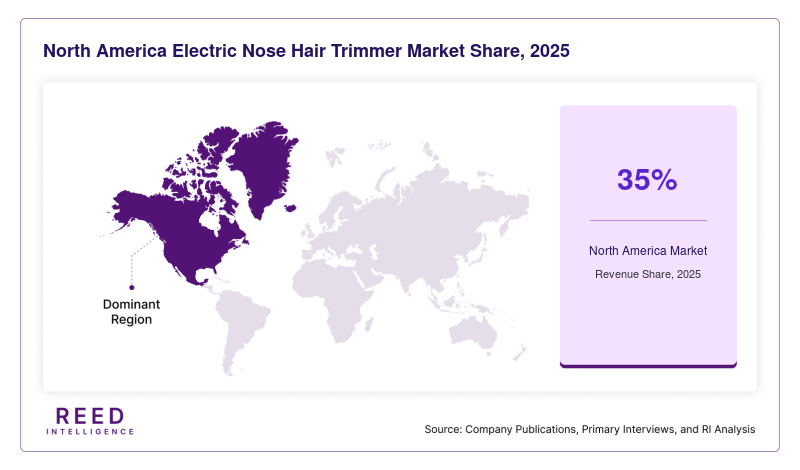
Holds a dominant position in the Electric Nose Hair Trimmer market, accounting for 35% of global sales, with the United States contributing USD 420 million in revenue for 2025. The region's mature grooming market, high disposable income levels, and strong brand presence drive robust demand. Canada represents a growing market, accounting for 12% of North American sales, with a CAGR of 5.5% projected through 2034. The Electric Nose Hair Trimmer market in North America is characterized by high product turnover, with average replacement cycles of 16 months, and strong preference for premium, feature-rich models.
Asia-Pacific Electric Nose Hair Trimmer Market
Stands as the fastest-growing region for the Electric Nose Hair Trimmer market, currently holding a 30% market share but projected to surpass North America by 2030. China leads regional demand, accounting for 45% of Asia-Pacific sales, with the country's grooming device market valued at USD 280 million in 2025. India and Southeast Asian nations are emerging as high-growth markets, with collective sales growing at 12% annually. The Electric Nose Hair Trimmer market in Asia-Pacific is driven by urbanization, rising disposable incomes, and increasing western grooming influences.
Europe Electric Nose Hair Trimmer Market
Represents the third-largest market, accounting for 22% of global sales, with Germany, the UK, and France together comprising 55% of the regional market. The European Electric Nose Hair Trimmer market is characterized by strong preference for sustainable and eco-friendly products, with 45% of consumers willing to pay a premium for recyclable packaging and energy-efficient devices. The region's strict safety and material standards influence product design, with CE-certified models dominating the market. Growth in Europe is projected at a steady CAGR of 4.2% through 2034.
Middle East & Africa and Latin America Electric Nose Hair Trimmer Market
Together account for the remaining 13% of the Electric Nose Hair Trimmer market, with the Middle East emerging as a key growth region driven by high per capita spending on luxury grooming products. Brazil leads the Latin American market, accounting for 45% of regional sales, with the country's grooming market benefiting from a large population and growing beauty consciousness. Both regions are projected to grow at CAGRs exceeding 7%, presenting attractive opportunities for market expansion.
Top players in Electric Nose Hair Trimmer Market
- Panasonic Corporation
- Philips N.V.
- Braun GmbH (Procter & Gamble)
- Wahl Clipper Corporation
- Remington Products Company
- Conair Corporation
- Andis Company
- Oster (Sunbeam Products)
- Syndicate Group
- Helen of Troy Limited
- Meridian Grooming
- Groomie
- VGR Nose Trimmer
- Brio
- Tomasso Brothers
Panasonic Corporation
Panasonic holds a dominant position in the Electric Nose Hair Trimmer market, with an estimated 15% global market share, particularly strong in the premium segment. The company's ER-series trimmers are renowned for their precision engineering, dual-edge blades, and hypoallergenic stainless-steel construction. Panasonic's market leadership is reinforced by its strong R&D capabilities, with the company holding over 200 patents related to grooming device technology. The company has invested approximately USD 75 million in grooming device R&D over the past two years, focusing on battery life improvement and blade longevity. Panasonic commands over 22% of the Japanese market and 18% of the North American premium segment, positioning it as a key player in the Electric Nose Hair Trimmer market's technological innovation landscape.
Philips N.V.
Philips is a leading player in the Electric Nose Hair Trimmer market, commanding approximately 12% global market share through its popular Norelco and Philips branded product lines. The company's Multi Groomer series, which includes nose trimmer attachments, has sold over 40 million units globally since its launch. Philips' strategic focus on ergonomic design and user-centric features, such as its proprietary Protective Guard technology and self-sharpening blades, has resonated strongly with consumers. The company's sustainability initiatives, including the use of recycled materials in packaging and carbon-neutral manufacturing, have strengthened its brand equity among environmentally conscious consumers. Philips holds a 20% market share in Western Europe and 15% in North America, making it a formidable competitor in the Electric Nose Hair Trimmer market.
Braun GmbH, a Procter & Gamble subsidiary, holds approximately 10% of the global market, with particular strength in the German and broader European markets, where it commands a 22% share. The company's expertise in precision engineering from its shaver portfolio has translated effectively into its nose trimmer offerings. Wahl Clipper Corporation, with a 9% global share, dominates the professional salon segment, accounting for 35% of barber-grade trimmer sales worldwide.
Recent Developments in Electric Nose Hair Trimmer Market
- 2025: Panasonic Corporation launched the ER-GN80, featuring a revolutionary dual-blade system with a 40% increase in cutting speed and USB-C fast charging capability, targeting the premium segment.
- 2025: Philips introduced the Norelco Multi Groomer 9000 with an AI-powered trimming head that automatically adjusts speed based on hair density, retailing at USD 89.99.
Electric Nose Hair Trimmer Market Segments
By Type
- Rotary Blade Trimmers
- Reciprocating Blade Trimmers
- Dual-Blade Trimmers
By Application
- Personal Grooming
- Professional Salons
- Medical Use
By Region
- North America
- Europe
- APAC
- Middle East and Africa
- LATAM