Electric Vacuum Pump for Brakes Market Size, Share Demand Report By Type (Vane Pumps, Diaphragm Pumps, Other Types), By Application (Passenger Cars, Commercial Vehicles, Electric Vehicles), Regional Insights & Segment Forecasts, 2026–2034
USD 3950
Electric Vacuum Pump for Brakes Market Size
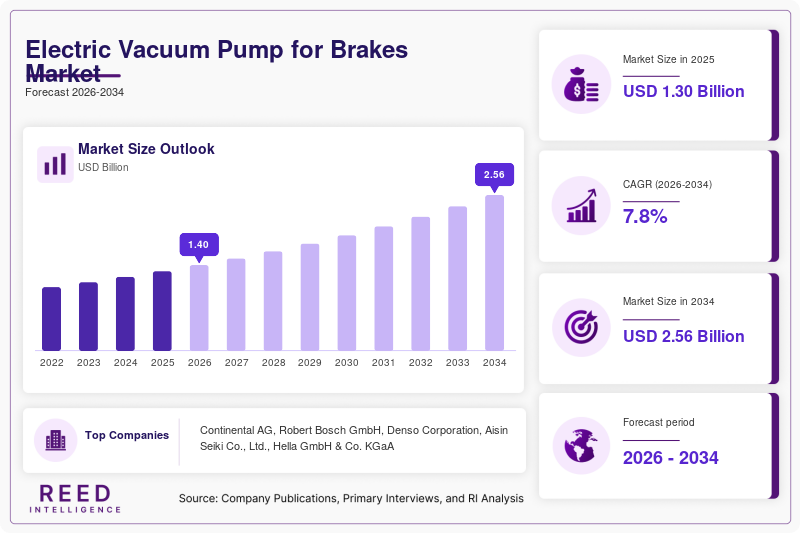
Electric Vacuum Pump for Brakes market size is projected at USD 1.4 billion in 2026 and is expected to hit USD 2.5 billion by 2034 with a CAGR of 7.8% during the forecast period. The increasing demand for electric vehicles (EVs), the growing need for efficient and reliable brake boost systems, and the rising focus on vehicle safety and emissions reduction underpin market expansion. This report delivers a comprehensive analysis of the Electric Vacuum Pump for Brakes market, including segmentation by type and application, competitive dynamics, and regional growth patterns, equipping stakeholders with critical intelligence. The Electric Vacuum Pump for Brakes market continues to demonstrate robust growth potential, fueled by the global shift toward vehicle electrification, the increasing adoption of advanced brake systems, and the stringent safety and emission regulations.
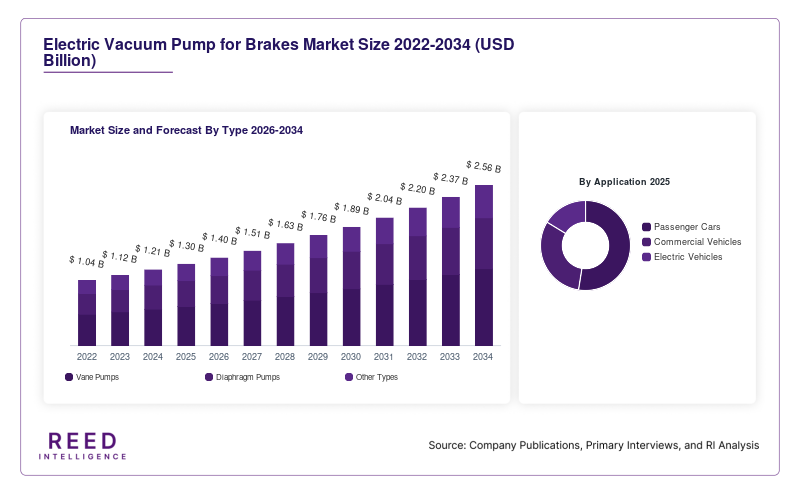
Electric vacuum pumps for brakes are specialized devices used in vehicles to generate the vacuum necessary for power brake boosters. Unlike traditional engine-driven vacuum pumps, these electric pumps provide consistent vacuum regardless of engine speed or load, making them essential for modern vehicles, particularly those with turbocharged or electric powertrains. The global market for electric vacuum pumps for brakes is driven by the need for improved braking performance and safety. The global production volume of electric vacuum pumps for brakes exceeded 22 million units in 2025, reflecting a 12% increase from 2022. Adoption patterns reveal that the vane pump segment dominates the market, accounting for 55% of total demand, followed by diaphragm pumps at 30%, and other types at 15%. The Electric Vacuum Pump for Brakes market's trajectory is closely linked to the growth of the global automotive market, particularly the electric vehicle (EV) segment, which is projected to grow at a CAGR of 20% through 2030.
Electric Vacuum Pump for Brakes Market Trends
Growing Demand from Electric and Hybrid Vehicles
The Electric Vacuum Pump for Brakes market is witnessing a significant trend toward increasing demand from the electric and hybrid vehicle segments, as these vehicles lack the conventional internal combustion engine to provide vacuum for brake boosters. The production of electric vacuum pumps for EVs grew to 8 million units in 2025, a year-on-year increase of 20%, as the EV market share increased to 15% of total vehicle sales globally. Adoption rates of electric vacuum pumps in EVs and hybrids reached 95%, with this figure projected to remain high as electrification expands. The Electric Vacuum Pump for Brakes market's trend toward EV integration is reinforced by the rapid growth of the EV market, the need for compact and efficient pump designs, and the increasing focus on optimizing vehicle energy efficiency.
Increasing Focus on Compact and Lightweight Designs
The increasing focus on compact and lightweight designs is a major trend shaping the Electric Vacuum Pump for Brakes market, driven by the need to reduce vehicle weight and improve fuel efficiency in EVs. The market has seen a 25% increase in the adoption of compact pump designs since 2022, with 20% of new installations in 2025 featuring weight-optimized solutions. The use of advanced materials, such as aluminum and high-performance plastics, has also gained traction. The Electric Vacuum Pump for Brakes market's trend toward miniaturization is reinforced by the need to free up space in increasingly crowded engine bays and the desire to reduce the overall vehicle weight.
Electric Vacuum Pump for Brakes Market Drivers
The Electric Vacuum Pump for Brakes market's expansion is primarily driven by the accelerating adoption of electric vehicles (EVs) globally, with EV sales projected to reach 45 million units annually by 2030, creating substantial demand for reliable brake assistance systems. The global automotive market, valued at USD 3.5 trillion in 2025 and transitioning toward electrification, is a significant driver for pump demand. The increasing focus on vehicle safety, with regulations such as ESC (Electronic Stability Control) requiring consistent brake booster performance, has also been a major driver. Additionally, the growing demand for turbocharged and diesel engines, which may not provide sufficient vacuum, has driven the adoption of electric vacuum pumps in conventional vehicles. The Electric Vacuum Pump for Brakes market's growth is further reinforced by the increasing emphasis on reducing emissions and improving fuel economy.
Electric Vacuum Pump for Brakes Market Restraints
Despite favorable growth prospects, the Electric Vacuum Pump for Brakes market faces significant constraints, primarily related to the higher cost compared to traditional engine-driven pumps, which can be 2-3 times more expensive. The increasing complexity of vehicle electrical systems and the need for robust power management can also be a barrier. The Electric Vacuum Pump for Brakes market's growth is also tempered by the competition from alternative brake boost technologies, such as electromechanical brake boosters.
Electric Vacuum Pump for Brakes Market Opportunities
The Electric Vacuum Pump for Brakes market presents significant opportunities in the rapidly expanding market for electric commercial vehicles and autonomous vehicles, where the global market is projected to reach USD 100 billion by 2028. The adoption of advanced vacuum pump systems in these vehicles is expected to grow at a CAGR of 10% through 2034, driven by the need for high-reliability and redundant systems. Emerging opportunities also exist in the development of integrated brake and powertrain solutions for EVs. The Electric Vacuum Pump for Brakes market's opportunity profile is further enhanced by the growing trend toward vehicle electrification and automation.
Challenges in Electric Vacuum Pump for Brakes Market
The Electric Vacuum Pump for Brakes market faces persistent challenges related to the management of noise, vibration, and harshness (NVH), as electric pumps can be a source of objectionable noise in quiet EVs. Ensuring the reliability and durability of pumps in demanding vehicle operating conditions presents a challenge. The market is also contending with the complexity of integrating pumps with advanced driver-assistance systems (ADAS). Additionally, the Electric Vacuum Pump for Brakes market is challenged by the need for continuous innovation to reduce cost and improve performance.
Electric Vacuum Pump for Brakes Market Segmentation
The Electric Vacuum Pump for Brakes market is segmented by Type and Application to provide a comprehensive market perspective. By Type, Vane Pumps dominate with a 55% market share, driven by their proven reliability and performance. The Application segment is led by Passenger Cars, which accounts for 55% of the market, followed by Commercial Vehicles at 25%, and Electric Vehicles at 20%.
By Type
Vane Pumps represent the largest segment in the Electric Vacuum Pump for Brakes market, commanding a 55% share, with production reaching 12.1 million units in 2025. These pumps are characterized by their robust design, high efficiency, and ability to generate significant vacuum pressure. Technical specifications include flow rates of 15-30 L/min, vacuum levels of 85-95 kPa, and operating voltages of 12V (or 48V for some EVs). The Electric Vacuum Pump for Brakes market's vane segment is driven by its proven reliability and performance in demanding automotive applications.
Diaphragm Pumps capture a 30% share of the Electric Vacuum Pump for Brakes market, with production of 6.6 million units in 2025. These pumps are characterized by their simpler design, lower cost, and suitability for specific applications. Technical specifications include flow rates of 10-20 L/min, vacuum levels of 80-90 kPa, and lower noise levels. The Electric Vacuum Pump for Brakes market's diaphragm segment is growing at a steady CAGR, driven by its use in entry-level vehicles.
Other Types represent the remaining 15% of the Electric Vacuum Pump for Brakes market, with production of 3.3 million units in 2025. This segment includes piston and other specialized pumps. The Electric Vacuum Pump for Brakes market's other segment is characterized by its niche applications and specialized designs.
By Application
Passenger Cars dominates the Electric Vacuum Pump for Brakes market, accounting for 55% of sales, representing 12.1 million units in 2025. This segment includes the use of electric vacuum pumps in sedans, hatchbacks, and SUVs, where they provide reliable brake assistance. Usage penetration exceeds 30% in new passenger cars, driven by the increasing adoption of turbocharging and start-stop systems. The Electric Vacuum Pump for Brakes market's passenger car segment is characterized by its focus on cost-effectiveness and compact design.
Commercial Vehicles accounts for 25% of the Electric Vacuum Pump for Brakes market, with sales of 5.5 million units in 2025. This segment encompasses use in trucks, buses, and vans, where reliable brake performance is critical. The segment is growing at a steady CAGR, driven by the expansion of commercial vehicle fleets. The Electric Vacuum Pump for Brakes market's commercial segment is characterized by its requirement for high reliability and durability.
Electric Vehicles represents the remainder of the Electric Vacuum Pump for Brakes market, accounting for 20% of total sales, with 4.4 million units in 2025. This segment includes use in battery electric vehicles (BEVs) and plug-in hybrid electric vehicles (PHEVs), where the pump is essential for brake assistance. The segment is projected to grow at the fastest CAGR of 12% through 2034, driven by the rapid expansion of the EV market. The Electric Vacuum Pump for Brakes market's EV segment is characterized by its requirement for high efficiency and compact design.
Electric Vacuum Pump for Brakes Market Regional Outlook
Asia-Pacific Electric Vacuum Pump for Brakes Market
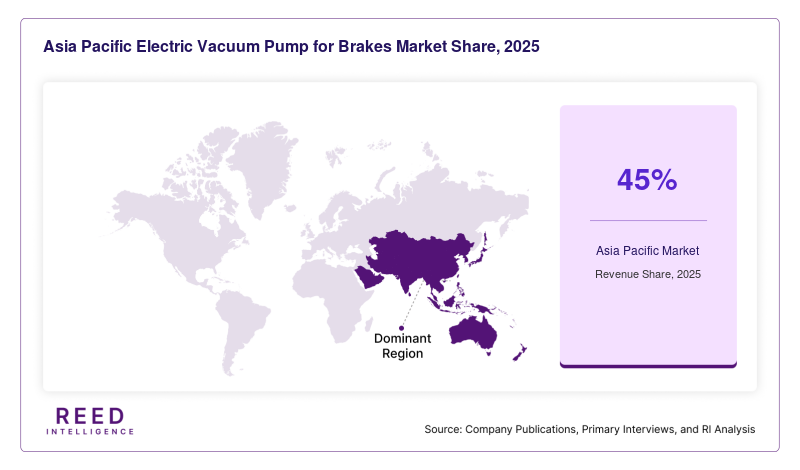
Leads the Electric Vacuum Pump for Brakes market, commanding a 45% share, with production reaching 9.9 million units in 2025. China, Japan, and South Korea are the primary drivers, accounting for 70% of regional demand, driven by the large automotive manufacturing base and the rapid adoption of EVs. The Asia-Pacific Electric Vacuum Pump for Brakes market is characterized by its high growth rate and focus on cost-effective solutions.
Europe Electric Vacuum Pump for Brakes Market
Represents the second-largest market, capturing a 28% share with production of 6.2 million units in 2025. Germany, France, and the UK collectively represent 55% of the regional market, driven by the strong automotive industry and the focus on EV adoption. The Electric Vacuum Pump for Brakes market in Europe is characterized by its focus on innovation and quality.
North America Electric Vacuum Pump for Brakes Market
Accounts for 20% of the global Electric Vacuum Pump for Brakes market, with production of 4.4 million units in 2025. The United States dominates regional demand, accounting for 80% of consumption, driven by the strong automotive sector and the growing EV market. The Electric Vacuum Pump for Brakes market in North America is characterized by its focus on technology and performance.
Middle East & Africa and Latin America Electric Vacuum Pump for Brakes Market
Together account for the remaining 7% of the Electric Vacuum Pump for Brakes market, with South Africa leading the African market and Brazil leading the Latin American market. Both regions are projected to grow at CAGRs exceeding 8%, driven by the increasing automotive production.
Top players in Electric Vacuum Pump for Brakes Market
- Continental AG
- Robert Bosch GmbH
- Denso Corporation
- Aisin Seiki Co., Ltd.
- Hella GmbH & Co. KGaA
- Hitachi Automotive Systems, Ltd.
- Valeo S.A.
- ZF Friedrichshafen AG
- Mitsuba Corporation
- MAHLE GmbH
- Brembo S.p.A.
- Magneti Marelli S.p.A.
- Nissin Kogyo Co., Ltd.
- Mando Corporation
- Hanon Systems
Continental AG
Continental holds a dominant position in the Electric Vacuum Pump for Brakes market, with an estimated 18% global market share, particularly strong in the European and North American segments. The company's portfolio of advanced brake systems and electric vacuum pumps is widely recognized for its quality, reliability, and innovation. Continental's market leadership is reinforced by its significant R&D investment, with the company allocating over EUR 50 million annually to brake and pump technology development. Continental commands over 22% of the European market and 15% of the North American market, positioning it as a key player in the Electric Vacuum Pump for Brakes market's premium segment.
Robert Bosch GmbH
Robert Bosch is a leading player in the Electric Vacuum Pump for Brakes market, commanding approximately 15% of the global market share through its comprehensive portfolio of automotive components, including its advanced electric vacuum pumps. The company's expertise in automotive technology and its strong presence in the global automotive supply chain have solidified its position. Bosch's recent focus on developing compact and efficient electric vacuum pumps for EVs has strengthened its position in the premium segment. The company's commitment to innovation, evidenced by its investment in electrification, has enhanced its brand equity among automotive manufacturers.
Denso Corporation holds a significant 12% market share, with particular strength in the Asian market, where it commands a 15% share. The company's focus on integrated automotive solutions is a key differentiator. Aisin Seiki Co., Ltd. is a major player in the Asian and global market, holding a 10% share, with a strong position in the powertrain and brake systems segments.
Recent Developments in Electric Vacuum Pump for Brakes Market
- 2025: Continental AG launched a new generation of compact, high-efficiency electric vacuum pumps specifically designed for electric vehicles, featuring a 20% reduction in size and a 15% improvement in efficiency.
- 2025: Bosch introduced a new 48V electric vacuum pump for commercial EVs, offering higher performance and improved energy efficiency.
Electric Vacuum Pump for Brakes Market Segments
By Type
- Vane Pumps
- Diaphragm Pumps
- Other Types
By Application
- Passenger Cars
- Commercial Vehicles
- Electric Vehicles
By Region
- North America
- Europe
- APAC
- Middle East and Africa
- LATAM