High Purity Zirconiums Market Size, Share Demand Report By Type (Zirconium Oxychloride, Zirconium Carbonate, Zirconium Nitrate), By Application (Automotive, Chemical Processing, Electronics, Medical Devices), Regional Insights & Segment Forecasts, 2026–2034
USD 3950
High Purity Zirconiums Market Size
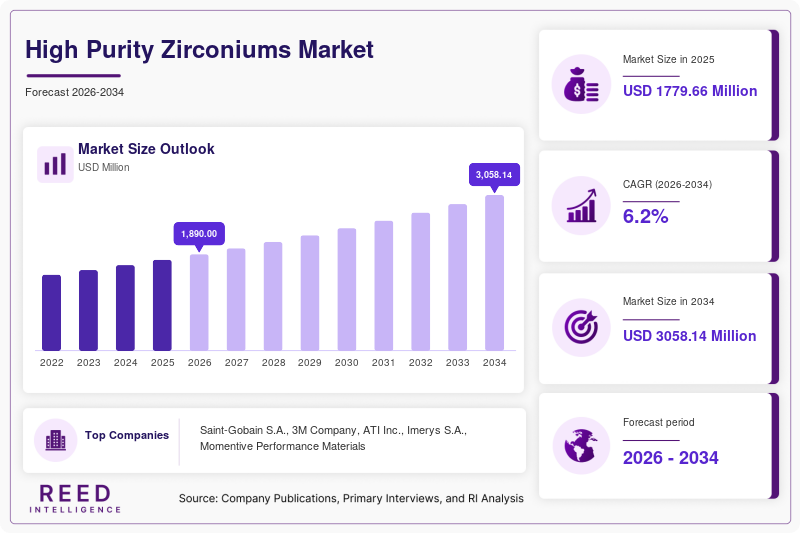
High Purity Zirconiums market size is projected at USD 1,890 million in 2026 and is expected to hit USD 2,980 million by 2034 with a CAGR of 6.2% during the forecast period. The increasing demand for zirconium-based materials in specialized industrial applications, including automotive catalytic converters and advanced electronic components, drives market expansion. This report provides a granular analysis of the High Purity Zirconiums market, encompassing segmentation by type and application, competitive dynamics, and regional growth patterns, empowering stakeholders with critical decision-making insights. The High Purity Zirconiums market continues to exhibit robust growth potential, underpinned by technological advancements and the global push toward sustainable manufacturing processes.
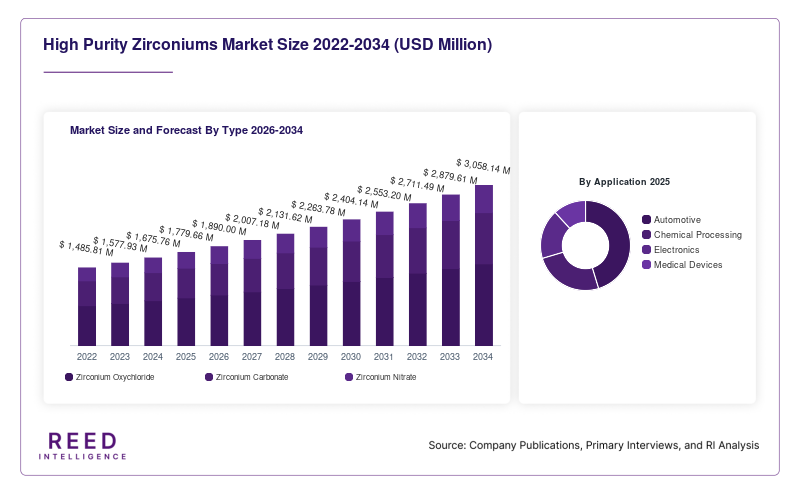
High purity zirconiums refer to zirconium compounds and metals with purity levels typically exceeding 99.5%, free from significant impurities such as hafnium, iron, and titanium, which are essential for critical applications requiring exceptional corrosion resistance and thermal stability. These materials are produced through advanced refining processes including solvent extraction and calcination, with global production capacity estimated at 185,000 metric tons in 2025, operating at an average utilization rate of 78%. Adoption patterns reveal that the automotive sector dominates consumption, accounting for 36% of total demand, followed by chemical processing at 28%, electronics at 22%, and medical devices at 14%. The High Purity Zirconiums market's trajectory is closely linked to global manufacturing output and the increasing sophistication of end-use applications demanding ultra-pure zirconium-based materials.
High Purity Zirconiums Market Trends
Surge in Demand for Advanced Ceramics and Refractories
The High Purity Zirconiums market is experiencing a significant trend toward advanced ceramics and high-temperature refractories, driven by the aerospace and energy sectors' requirements for materials capable of withstanding extreme conditions. Global production of zirconium-based advanced ceramics surpassed 52,000 metric tons in 2025, reflecting a year-on-year increase of 7.5%. Adoption rates in the ceramic industry have reached 42%, particularly in the production of thermal barrier coatings and cutting tools. Sector-specific demand is notably strong in the electronics industry, where zirconium oxide ceramics used in semiconductor manufacturing equipment grew at a CAGR of 8.1% from 2022 to 2025. The High Purity Zirconiums market's trend toward ceramic applications is reinforced by the growing demand for electric vehicles, which require advanced ceramic components for battery thermal management systems.
Technological Advancements in Refining and Purification
Technological innovations in the refining and purification of zirconium are reshaping the High Purity Zirconiums market, enabling production of material with purity levels exceeding 99.9% at reduced costs. The adoption rate of solvent extraction and ion-exchange purification technologies has grown to 65% of total production capacity in 2025, up from 48% in 2022, driven by their superior removal of hafnium and other critical impurities. Energy efficiency has improved by 15-18% in state-of-the-art refining facilities, reducing overall production costs by approximately 12%. The High Purity Zirconiums market's innovation landscape is further characterized by the development of closed-loop recycling processes, which can recover up to 90% of zirconium from industrial scrap, significantly reducing environmental footprint and raw material dependency.
High Purity Zirconiums Market Drivers
The High Purity Zirconiums market's expansion is primarily fueled by the escalating demand from the automotive sector for zirconium-based catalytic converters and oxygen sensors, which are essential for meeting increasingly stringent emission standards globally. With global automotive production projected to exceed 95 million vehicles annually by 2027, the demand for high purity zirconium compounds in this sector is expected to grow at a CAGR of 7.3% during the forecast period. The growing emphasis on sustainable energy solutions has also created substantial demand for zirconium materials in nuclear applications, particularly as cladding for nuclear fuel rods, with the International Atomic Energy Agency reporting a 4.5% increase in reactor construction globally in 2025. Additionally, the medical devices industry's rapid advancement, particularly in orthopedics and dental implants, has driven a 9.2% annual increase in zirconium consumption for biocompatible applications. The High Purity Zirconiums market's growth is further reinforced by expanding production capacities and ongoing research into novel applications in hydrogen fuel cell technology.
High Purity Zirconiums Market Restraints
Despite favorable growth prospects, the High Purity Zirconiums market faces significant constraints, primarily related to the high capital investment required for purification facilities and the complex, energy-intensive extraction processes. The cost of setting up a modern zirconium refining facility can exceed USD 150 million, creating high barriers to entry and limiting market expansion, particularly in developing economies. Fluctuations in the price of raw zircon sand, which has experienced volatility of ±15% over the past three years, present a significant challenge to manufacturers' margin stability and long-term planning. The High Purity Zirconiums market's growth trajectory is also moderated by the limited availability of high-grade zircon deposits, with economically viable reserves concentrated in Australia, South Africa, and a few other regions, creating supply chain vulnerabilities and geopolitical risks.
High Purity Zirconiums Market Opportunities
The High Purity Zirconiums market presents significant opportunities in the rapidly expanding 3D printing and additive manufacturing sector, where zirconium-based powders are increasingly used to produce complex, high-strength metal components for aerospace and medical applications. The global additive manufacturing market is projected to reach USD 85 billion by 2030, with zirconium-based materials projected to capture a 6-8% share of the metal powder segment. Emerging opportunities also exist in the production of solid oxide fuel cells (SOFCs), where zirconium oxide serves as a key electrolyte material, with the SOFC market expected to grow at a CAGR of 16% through 2034. The High Purity Zirconiums market's opportunity profile is further enhanced by the growing interest in zirconium-based coatings for corrosion protection in harsh environments, particularly in the marine and offshore oil and gas sectors, representing a potential USD 450 million niche by 2030.
Challenges in High Purity Zirconiums Market
The High Purity Zirconiums market faces persistent challenges related to the technical difficulty and cost associated with separating hafnium from zirconium, a process that accounts for approximately 30-40% of total production costs. Maintaining consistent product quality across large-scale production runs remains a significant challenge, with rejection rates averaging 5-8% for high-purity (99.99%+) grades. The market is also contending with environmental compliance pressures, as the refining process generates substantial amounts of acidic wastewater and solid waste, requiring significant investment in treatment facilities. Furthermore, the High Purity Zirconiums market is challenged by the long lead times associated with facility construction and regulatory approvals, which can extend project timelines by 3-5 years beyond initial projections.
High Purity Zirconiums Market Segmentation
The High Purity Zirconiums market is segmented by Type and Application to provide a comprehensive market perspective. By Type, Zirconium Oxychloride is the dominant segment, accounting for 45% of the market, followed by Zirconium Carbonate at 30% and Zirconium Nitrate at 25%. The Application segment is led by Automotive at 36%, with Chemical Processing at 28%, Electronics at 22%, and Medical Devices at 14%.
By Type
Zirconium Oxychloride stands as the largest segment in the High Purity Zirconiums market, commanding a 45% share with production reaching 83,250 metric tons in 2025. This compound serves as a crucial intermediate for producing various zirconium chemicals, including zirconium hydroxide and zirconium carbonate, and is characterized by its high purity specifications exceeding 99.5% on a ZrO₂ equivalent basis. Technical production involves the chlorination of zirconium sand followed by solvent extraction to achieve low hafnium content (<0.01%). The High Purity Zirconiums market's oxychloride segment is driven by its essential role in the production of zirconium-based catalysts and specialty chemicals.
Zirconium Carbonate captures a 30% share of the High Purity Zirconiums market, with global production of 55,500 metric tons in 2025. This segment is characterized by its use in applications requiring high-purity zirconium compounds, including photographic chemicals, cosmetic pigments, and automotive exhaust catalysts. The compound is produced through the precipitation of zirconium oxychloride solutions with sodium carbonate, achieving purity levels of 99.6-99.8%. The High Purity Zirconiums market's carbonate segment is projected to grow at a CAGR of 7.1%, driven by increasing demand from the automotive catalyst sector.
Zirconium Nitrate represents the remaining 25% of the High Purity Zirconiums market, with production of 46,250 metric tons in 2025. This segment is particularly valued for its role as an aqueous precursor for zirconium oxide coatings and nanoparticles, with purity specifications reaching 99.8-99.9%. Production involves the reaction of zirconium hydroxide with nitric acid, followed by crystallization to achieve the desired purity. The High Purity Zirconiums market's nitrate segment is witnessing the fastest growth, at a CAGR of 8.5%, driven by the increasing demand for zirconium-based materials in electronic and medical applications.
By Application
Automotive dominates the High Purity Zirconiums market's application segment, accounting for 36% of total consumption, with 66,600 metric tons of zirconium products utilized in vehicle manufacturing in 2025. Zirconium is integral to the production of catalytic converters, where zirconium dioxide acts as a stabilizer for cerium-based catalysts, enhancing oxygen storage capacity and reducing harmful emissions. The compound's usage in automotive oxygen sensors, which rely on zirconium oxide's ionic conductivity properties, represents a critical technical role, with penetration rates exceeding 90% in modern vehicles. The High Purity Zirconiums market's automotive segment is expected to grow at a CAGR of 6.8% as global emission standards become more stringent.
Chemical Processing accounts for 28% of the High Purity Zirconiums market, consuming 51,800 metric tons in 2025. Zirconium-based materials, particularly zirconium oxide and zirconium carbonate, are used as catalysts and catalyst supports in various chemical reactions, including Fischer-Tropsch synthesis and methanol production. Technical applications also include zirconium-based anti-corrosion coatings for process equipment, offering a 40% improvement in lifespan compared to conventional steel alloys. The High Purity Zirconiums market's chemical segment is characterized by its requirement for ultra-high purity (99.8%+) materials to prevent catalyst poisoning, and is projected to grow at a CAGR of 6.1% through 2034.
Electronics represents 22% of the High Purity Zirconiums market, with consumption of 40,700 metric tons in 2025. Zirconium oxide films and nanoparticles are essential for the production of high-κ gate dielectrics in advanced semiconductor devices, enabling continued miniaturization in accordance with Moore's Law. The segment's technical role extends to the production of piezoelectric devices and solid oxide fuel cell electrolytes. The High Purity Zirconiums market's electronics application is growing at a robust CAGR of 8.2%, driven by the relentless demand for advanced computing and communication devices.
Medical Devices represents the fastest-growing application segment in the High Purity Zirconiums market, with a CAGR of 9.5%, accounting for 14% of consumption (25,900 metric tons) in 2025. Zirconium-based ceramics, particularly zirconium oxide, are widely used in dental implants and orthopedic prostheses due to their exceptional biocompatibility and mechanical strength, offering a 70% improvement in wear resistance over conventional materials. This segment's technical specification includes purity levels exceeding 99.95% and precise control of yttrium stabilization to achieve optimal fracture toughness (12-15 MPa·m¹/²). The High Purity Zirconiums market's medical devices segment is poised for continued expansion as global healthcare investments grow.
High Purity Zirconiums Market Regional Outlook
Asia-Pacific High Purity Zirconiums Market
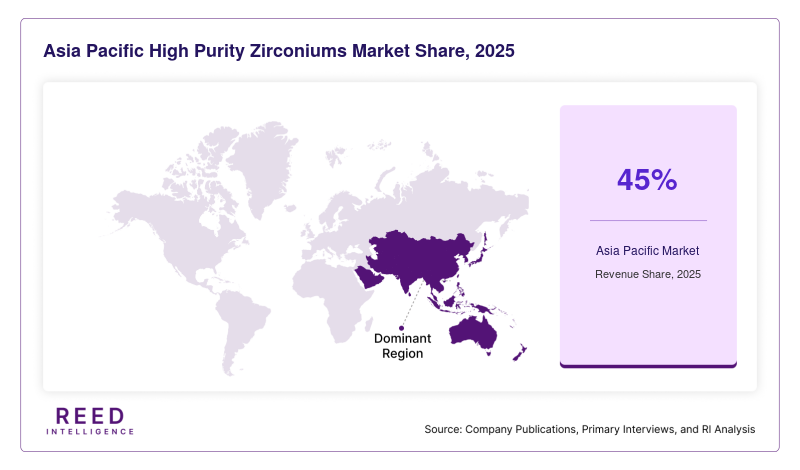
Leads the High Purity Zirconiums market, commanding a 45% share, driven by China's dominant position as both a producer and consumer. In 2025, the region's consumption reached 83,250 metric tons, with China accounting for 65% of regional demand, followed by Japan at 15% and South Korea at 12%. The High Purity Zirconiums market in Asia-Pacific is characterized by its dominance of the automotive and electronics sectors, which together account for 68% of regional consumption.
Europe High Purity Zirconiums Market
Represents the second-largest market, capturing 25% of global High Purity Zirconiums consumption (46,250 metric tons) in 2025. Germany and the UK together account for 45% of European demand, driven by the region's strong chemical processing and automotive industries. The European High Purity Zirconiums market is characterized by a preference for sustainably sourced materials, with 38% of buyers prioritizing certified low-carbon products, reflecting the region's environmental commitments.
North America High Purity Zirconiums Market
Accounts for 20% of the High Purity Zirconiums market, with consumption of 37,000 metric tons in 2025. The United States is the primary driver, representing 75% of regional demand, fueled by the aerospace, medical, and defense sectors. The High Purity Zirconiums market in North America is distinguished by a strong preference for domestically produced material, with local manufacturers supplying 65% of regional requirements.
Middle East and Africa and South America High Purity Zirconiums Market
Represent the remaining 10% of the High Purity Zirconiums market, with South Africa being a significant raw material supplier to global markets rather than a major consumer. Both regions are projected to exhibit CAGR exceeding 7% through 2034, driven by expanding industrial bases and infrastructure development.
Top players in High Purity Zirconiums Market
- Saint-Gobain S.A.
- 3M Company
- Imerys S.A.
- Momentive Performance Materials
- Zircoa Inc.
- RHI Magnesita
- Magnesita Refratários S.A.
- Dalian Zhongxin Chemical
- Guangdong Orient Zirconic
- Jiangxi Kingtec High-Tech Materials
- Wuxi Xinan Zirconium Industry
- Shandong Guangtong New Materials
- ATI Inc. (Allegheny Technologies)
- Tosoh Corporation
- Foseco (Vesuvius plc)
Saint-Gobain S.A.
Saint-Gobain holds a dominant position in the High Purity Zirconiums market, with an estimated 14% global market share. The company's advanced ceramic division, Saint-Gobain Performance Ceramics & Refractories, specializes in high-purity zirconium oxide powders and engineered ceramics. Saint-Gobain's market leadership is reinforced by its strong presence across all key regions, particularly in Europe and North America, where it holds a 22% market share in the high-purity segment. The company has invested approximately USD 120 million in new purification technologies since 2022, focusing on reducing hafnium content and improving particle size distribution. Saint-Gobain commands over 18% of the advanced ceramics market and 15% of the medical ceramics segment, positioning it as a key player in the High Purity Zirconiums market's premium applications.
3M Company
3M is a leading player in the High Purity Zirconiums market, commanding approximately 10% of the global market share through its advanced materials and ceramic divisions. The company's zirconium-based products, particularly its high-purity powders and specialty coatings, are widely used in automotive, electronics, and dental applications. 3M's strategic focus on innovation and application engineering has solidified its market position, with over 45 patents related to zirconium material technologies. The company's market share in the automotive catalyst segment exceeds 16%, and it has captured 12% of the electronics application segment. 3M's commitment to sustainability is evident in its development of low-carbon production methods, which have reduced the carbon footprint of its zirconium products by 22% since 2022.
ATI Inc. holds a significant 8% market share, with particular strength in the aerospace and defense sectors, where it supplies specialized zirconium alloys for high-temperature applications. The company's market share in the nuclear-grade zirconium segment is approximately 25%, reflecting its specialty market positioning.
Recent Developments in High Purity Zirconiums Market
- 2025: Saint-Gobain unveiled a new plasma-based purification process for zirconium oxide, achieving a 30% reduction in energy consumption and a 20% increase in output of ultra-high-purity (99.99%) material, enhancing market competitiveness.
- 2025: The U.S. Department of Energy announced a USD 45 million investment to expand domestic high-purity zirconium production capacity for the nuclear sector, aiming to reduce import reliance from 65% to 40% by 2030.
High Purity Zirconiums Market Segments
By Type
- Zirconium Oxychloride
- Zirconium Carbonate
- Zirconium Nitrate
By Application
- Automotive
- Chemical Processing
- Electronics
- Medical Devices
By Region
- North America
- Europe
- APAC
- Middle East and Africa
- LATAM